

Guidance on broadband speeds
Broadband can be confusing.
The connection delivered to your router, the Wi-Fi around your home and the amount of internet your household is using at a busy moment are three different things.
This guide explains how they fit together, why a fibre upgrade can change Wi-Fi coverage, and how to test which part of the connection is actually slowing you down.
Getting to know broadband speeds
A faster broadband package gives your household more capacity, but it does not automatically make Wi-Fi stronger in every room.
Equally, excellent Wi-Fi cannot create more capacity than the broadband connection provides.
A more useful question than “what is the fastest broadband I can buy?” is: “Is my broadband connection fast enough for what we do at the same time, and is my Wi-Fi delivering that connection properly around the home?”
If you're moving to fibre broadband
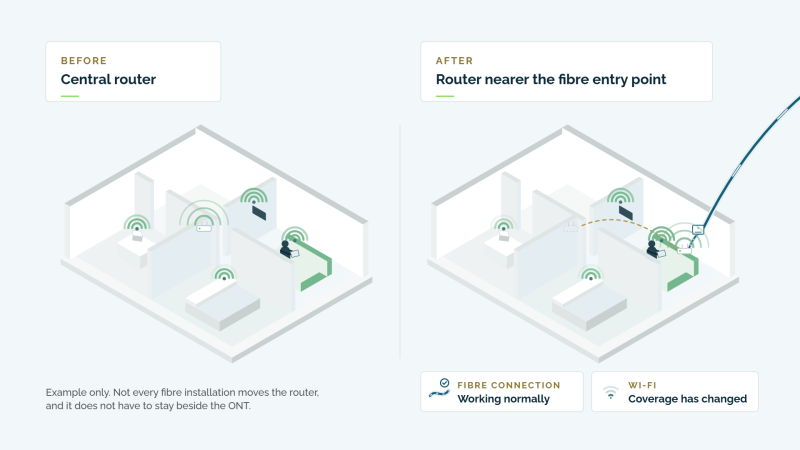
Before a fibre installation ask where the ONT will be fitted, where the router will sit, whether that position is likely to provide Wi-Fi coverage to the rooms you use most, and what options are available if the preferred router position is elsewhere.
What should I agree before the installation?
Before work starts, it is worth discussing where the new fibre equipment will go. In particular, ask:
- Where will the fibre enter the property?
- Where will the ONT be fitted? The ONT is the small unit where the fibre connection terminates inside the home.
- Where will the router be positioned?
- Is that a good position for Wi-Fi? A router near one edge of the property may not serve rooms at the other end as well as a more central position.
- Are there other options? Depending on the installation, it may be possible to use Ethernet cabling so that the router or an additional Wi-Fi access point can be positioned somewhere more suitable.
The best place for the fibre to enter your home is not necessarily the best place for your Wi-Fi router.
What should I check after fibre is installed?
Once the new connection is live, check Wi-Fi in the places where you actually use it — not just beside the router.
Try your phone, tablet or laptop in rooms such as the lounge, bedroom or home office and compare the experience with the areas close to the router.
If the broadband connection is performing well near the router but Wi-Fi is noticeably poorer elsewhere, the issue may be coverage rather than the fibre connection itself.
Possible solutions can include:
- repositioning the router where practical;
- connecting equipment using Ethernet;
- adding a suitable Wi-Fi access point or mesh system;
- repositioning existing Wi-Fi equipment.
Buying a faster broadband package will not necessarily improve weak Wi-Fi coverage.

Check before you buy
In this section, we explain what a travel eSIM is and why it might be useful when travelling.
We also cover what to check when reviewing providers, including terms, refunds, complaints, customer support, personal data, and phone compatibility.
What is a Travel eSIM?
Travel eSIMs are often bought for use in a specific country, region or group of countries. They are usually bought before travelling and include a fixed allowance, such as a set amount of data for a set number of days.
Some travel eSIMs are data-only. These are often cheaper and may be suitable if you mainly use apps such as WhatsApp, FaceTime, Google Maps, email or social media, like Facebook and TikTok.
Other travel eSIMs include data, calls and texts. These may be useful if you need a local number, expect to make standard calls, or need to send or receive text messages. However, combined packages can cost more, include less data, or be available in fewer destinations.
Before buying, check whether the eSIM includes data only, calls and texts, a local number, text support, top-ups and emergency calling.
Is a Travel eSIM right for you?
| People often choose a travel eSIM because it can: | |
|---|---|
| ✓ | be cheaper than roaming |
| ✓ | give better control over costs |
| ✓ | be bought before travelling |
| ✓ | avoid the need for a physical SIM card |
| ✓ | provide mobile data as soon as you arrive |
| ✓ | allow you to keep your normal SIM active while using the eSIM for data |
However, a travel eSIM is not always the best option. Roaming with your on-island provider may be simpler, will keep your normal number fully active, and may come with better local support.
Use the table below to help you decide which one is right for you:
| Feature | Roaming | Travel eSIM |
|---|---|---|
| Uses your normal mobile number | Usually yes | Usually no |
| Uses your existing plan | Yes | No, usually a separate plan |
| Simple to use | Usually yes | Usually, but setup may be needed |
| Cost control | Depends on your on-island provider | Often pre-paid with a fixed allowance |
| Calls and texts | Usually included | Not always; many are data-only |
| Local support | Usually through your on-island provider | Depends on the eSIM provider |
| Local consumer protection | More likely if using a local licensed on-island provider | May be limited if the provider is based outside Guernsey |
Check travel eSIM providers carefully
Many travel eSIM providers are based outside Guernsey. If you buy from a provider that is not regulated in Guernsey, you may not have the same level of protection as you would when buying from a Guernsey regulated telecoms provider.
Before you buy, check the provider’s terms and conditions carefully. In particular, look at:
| What to check | Why it matters |
|---|---|
| What service is being provided | Check whether the plan includes data only, or data, calls and texts. |
| Coverage | Check that the eSIM works in the country or countries you are visiting. |
| Refunds | Check whether you can get a refund if the eSIM does not work, is not installed, or is not used. |
| Complaints | Check how to complain if something goes wrong. |
| Dispute resolution | Check what happens if you and the provider cannot resolve a complaint. |
| Customer support | Check how support is provided, when it is available, and whether it is available while you are abroad. |
| Personal information and communications data | Check what personal information the provider collects and how it will be used, stored and protected. You should also check what steps the provider takes to protect the privacy and confidentiality of your calls, texts and data usage. |
| Plan dates and expiry | Check when the plan starts, how long it lasts, and whether it expires after a set period. You should also check if the service automatically renews at the end of the set period. |
Phone Compatibility
Many modern phones allow you to use a physical SIM and an eSIM at the same time, or more than one eSIM. This can let you keep your normal number active while using a travel eSIM for mobile data.
Travel eSIMs can only be used on unlocked phones, which are phones that are not "locked" to a specific mobile provider. Typically, phones supplied by local licensed mobile providers are not locked, but you should check whenever purchasing a new phone, especially when purchasing online.
Many modern phones support travel eSIMs, including:
| Manufacturer | General guidance |
|---|---|
| Apple iPhone | iPhone XS, XR and later, including iPhone 11 and later models, generally support eSIM. |
| Samsung Galaxy | Many recent Galaxy S and Galaxy Z models support eSIM, including many Galaxy S20 and later models. |
| Google Pixel | Pixel 4 and later models generally support eSIM. Some earlier Pixel models may also support eSIM, depending on where they were bought. |
This is only a general guide. Before buying a travel eSIM, check that your exact phone model supports eSIMs, is not locked to another mobile provider, and is compatible with the travel eSIM provider’s service.
Choose and use with confidence
In this section, we help you compare the main provider options and decide which type of travel eSIM may be right for your trip.
We also explain how to install and use a travel eSIM, avoid unexpected roaming charges, and use the checklist before you go.
Which Travel eSIM is right for me?
There is no single best option. The right choice depends on where you are travelling, how long you are away, how much data you need, whether you need calls and texts, and what support you want if something goes wrong.
| Option | Positives | Things to consider |
|---|---|---|
| Local licensed mobile provider | Local customer support; subject to Guernsey telecoms obligations; local consumer support may be available where appropriate | May be more expensive than some travel eSIM options |
| Well-known travel eSIM brand, such as Airalo, Holafly or Nomad | Easy to compare plans; often app-based; good for data-only travel use | May be based outside Guernsey; many plans are data-only; support may be limited |
| Provider based in the country you are visiting | May offer good local value, coverage, calls or texts | Support may be harder to access; local rules, identity checks or language barriers may apply |
Consumers may benefit from using local licensed providers where local support and regulatory protections are important to them. This is particularly the case when islanders have roaming included in their local plan.
Some global travel eSIM providers operate entirely online and based outside of Guernsey. This does not mean the service is unsuitable, but it may affect what help is available if something goes wrong.
Before buying, check who the provider is, where the travel eSIM works, what is included, how long it lasts, whether top-ups are available, and what the refund or complaints process is.
Using a Travel eSIM
Always follow the provider’s instructions.
Some travel eSIMs can be installed before you travel and only activate when you arrive. Others may start as soon as they are installed. This is important because many travel eSIMs are valid only for a fixed number of days after activation.
Before you travel, it is sensible to:
| Action | Why it helps |
|---|---|
| Install the eSIM before you leave, if the provider recommends this | It gives you time to fix any setup problems. |
| Check when activation starts | Avoid starting the plan too early. |
| Save the installation instructions | You may need them if the eSIM does not work abroad. |
| Keep your normal SIM active if needed | This may allow you to receive calls, texts or security codes. |
| Check which SIM is being used for data | This helps avoid unexpected roaming charges. |
| Turn off data roaming on the SIM you do not want to use abroad | This can help avoid bill shock. |
An app should help you install the travel eSIM, check compatibility, track data usage, top up, and contact customer support.
After installing a travel eSIM, check your phone settings carefully. Make sure you know which SIM your phone will use for mobile data, calls and texts. If you want to avoid unexpected roaming charges, you will need to turn off data roaming on your normal SIM and select the travel eSIM for mobile data.
Our Travel eSIM Checklist
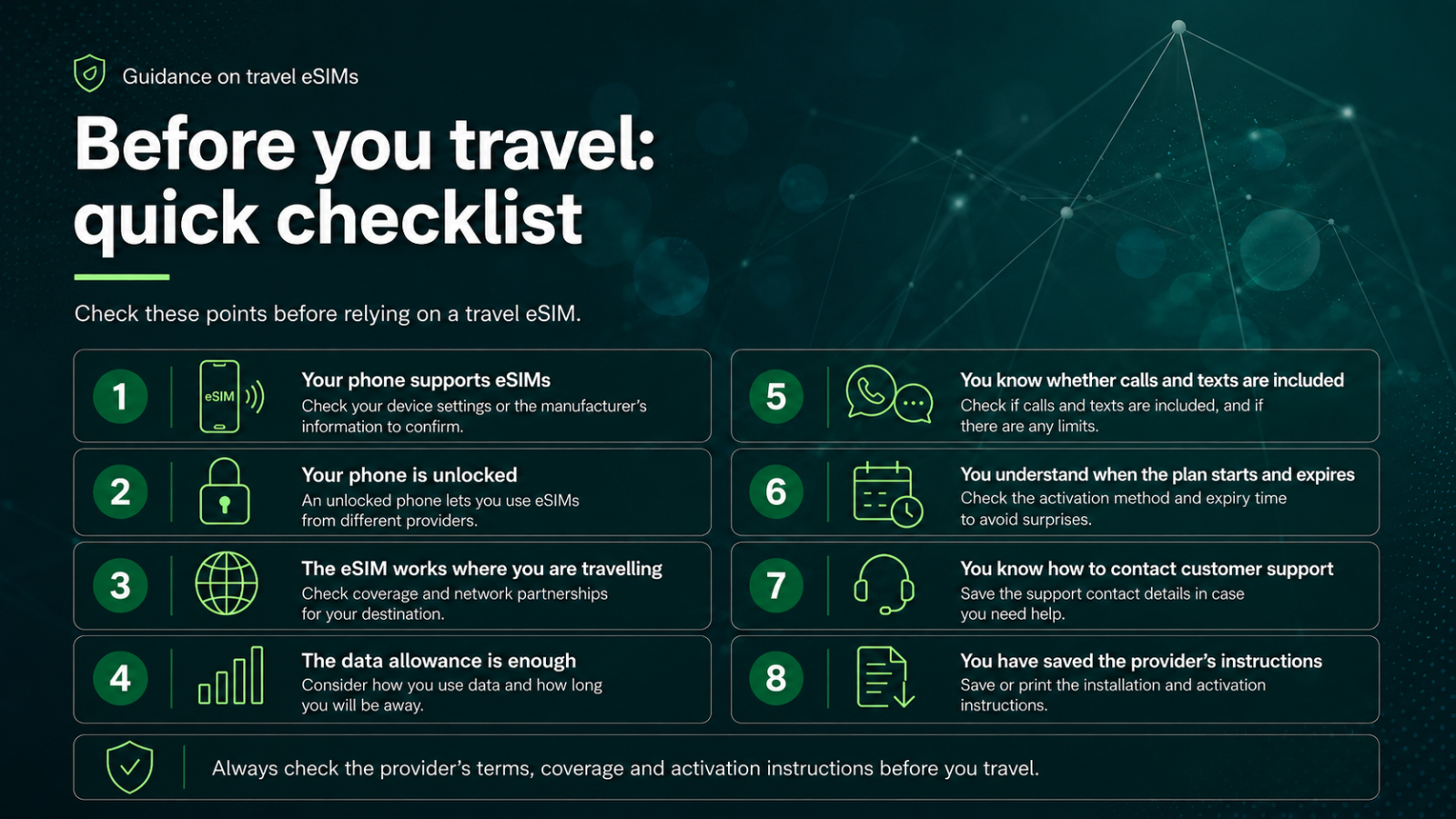
Download this checklist for your device.